Inside one ops leader's playbook for cleaning up cyber and IT chaos without micromanaging it.
Featuring Chris Newman, in conversation with Cyberleaf
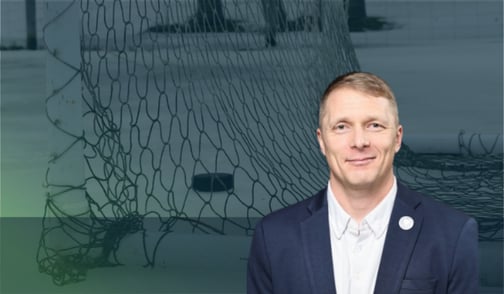
Chris Newman has spent his career in environments where the cost of a wrong call is not measured in dollars. Seven years as a Navy SEAL, nearly two decades in the CIA, and a move into private capital after retirement, where he carried responsibility for IT and cybersecurity across more than a dozen portfolio companies. More recently, he holds a senior operating role inside a permanent-capital holding structure professionalizing a fast-growing, multi-site business.
He is, by his own description, not a tech person. What he is, instead, is a serious operator who has learned to ask one stubbornly unglamorous question over and over: are we getting what we are paying for?
It is the question that, in two different organizations now, eventually led him to Cyberleaf.
The False Sense of Security
Chris sees a remarkably consistent pattern across the companies he's worked with businesses that have grown faster than their operational discipline. IT and cybersecurity get treated as a checkbox rather than a strategy, so tools accumulate like sediment. Endpoint detection no one is monitoring, MFA users can turn off at will, incident response plans that have never been tested, and phishing training capabilities purchased but never deployed.
The spend was real, the protection was not.
"CEOs will look at IT spend and think that equates security. We spent $1.3 million last year on cybersecurity. We have MFA. Okay, you have MFA—but is it really enforced?"
— Chris Newman, on the cybersecurity blind spot
The deeper problem, in his experience, is a quiet dynamic wherein IT staff who knew they were behind the curve didn't want to admit it. Faced with a torrent of help-desk tickets and no time to think strategically, they would layer on more tools, band-aids, in his words, on a gunshot wound. He calls it "the tyranny of the now," and he uses the phrase with empathy. Most IT teams are understaffed and overwhelmed. They fail because no one has given them the air cover to stop, reset, and look honestly at where the gaps really are.
Stop. Reset. Be Honest.
This is the moment, Newman says, where the right partner either earns its place or becomes another vendor. His framing for the existing IT team, the one he has used in multiple organizations, is plain: this is not a gotcha exercise, but it will become one if you aren't transparent.
What follows is a baseline assessment designed not to humiliate the team in place but to surface what is real. Where are the gaps? Where is money being wasted on overlapping tools? Where is the existing staff genuinely strong, and where are they being asked to do work they were never trained for?
"It's not an ego-measuring type thing or coming in and showing you what right looks like. They do a great job of working with the existing team, and also letting me know, hey, you've got a problem here."
— Chris Newman, on Cyberleaf's diagnostic style
The Fractional Bench Most Companies Can't Hire
There's a structural problem in the middle market no one talks about plainly: a company with several hundred million in revenue can't build the cybersecurity team it really needs on its own. The talent is too scarce, too expensive, too specialized. You might hire one strong leader, you can't hire ten.
This is where the partnership model earns its keep. Newman explains that Cyberleaf functions as a fractional bench of senior expertise, a roster of specialists drawn on as the situation demands. The internal team isn't replaced, it's upgraded. A capable in-house leader who'd otherwise have to bluff through unfamiliar territory now has experts to call.
The strong in-house people, Newman notes, light up at the chance. "The really good IT guys are like, holy crap, I get to work with somebody like this. And you say, yeah, you do." Confidence rises, standards rise, and the teammates who can't or won't rise with them become visible.
Humility vs. Arrogance
Across years of acquiring, integrating, and exiting businesses, Newman has seen a clear pattern in which organizations get cybersecurity right and which ones don't. The differentiator is not budget or headcount. It's not even technical sophistication, in fact, some of the most technically self-confident organizations turn out to be the most exposed.
The differentiator is humility. The companies that thrive after a partner comes in are the ones whose leaders can say, plainly, "I know we have an issue here. I just haven't had the time to get to it." The ones that struggle insist, "No, no, we've got this." Either you embrace the assessment, in his framing, or you start trying to cover up. The choice usually predicts the outcome.
"A win is a win for everybody, and a loss is a loss for everybody. The biggest weakness is arrogance, believing you don't have anything to learn or anything you can do better."
— Chris Newman, on the cultural condition that makes the work succeed
The Force Multiplier
Newman has now brought Cyberleaf into two private equity firms and over a dozen individual businesses. The starting conditions in each were different, but the playbook was largely the same: assess honestly, consolidate the stack, enforce what was already supposed to be enforced, install the right people in the right seats, and build a strategy that survives the day-to-day.
Asked what has changed most in his daily life as a result, his answer is striking for what it does not include. He does not lead with technology or metrics; he leads with attention.
"The biggest force multiplier of Cyberleaf is I really don't have to micromanage them. Once they get a good foothold, get the right people and engagements, and understand what we're trying to do, you can kind of walk away from it. And that is huge, because then I can go work on HR, or restructuring this or costing out something, or the other things I have to do."
— Chris Newman, on what changes in the day-to-day
Senior operators are not paid to manage cybersecurity in detail; they are paid to allocate scarce attention across an enormous range of competing priorities. A partner that requires constant supervision isn't a partner at all; they're another item on the list. A partner that can be pointed in the right direction and trusted to execute returns the most valuable resource an executive has: the ability to think about something else.
Asked directly what changes day-to-day after Cyberleaf comes in, Newman's answer is unhedged: "A better overall IT infrastructure and security posture with less cost. Generally, less cost depending upon the initial spend." Redundant tools get cut, misallocated spend gets redirected, standalone products get retired in favor of capabilities the organization was already paying for inside its existing license stack. Cost reduction and posture improvement, in his telling, are not separate wins to be ranked. They are two visible outputs of the same underlying work: getting resource allocation right.
He keeps returning to the people. The technical depth is real, he calls watching Cyberleaf CEO Jeff Buss work a live ransomware incident, calmly five steps ahead of the attackers, one of the coolest things he has seen in his career. But what makes the engagement work day-to-day is something quieter. "It's the people that make the difference," he says. "Everybody just makes the team feel comfortable."
For a leader weighing whether to bring in a strategic cybersecurity partner, Newman's counsel is direct. Open the books and embrace the assessment rather than fight it. Recognize that the in-house team is probably not the problem, they've been trapped in the tyranny of the now, and they need air cover to stop, reset, and build something that lasts. Find a partner who will provide that air cover without ego.
And then go do the rest of your job.
.png?width=95&height=125&name=Threat%20Report%20(1).png)