


Part two of Play Your Position, a Cyberleaf series on the lessons in Ken Dryden's The Game. This one takes on "failure can't be outsourced" from the sales leadership side.
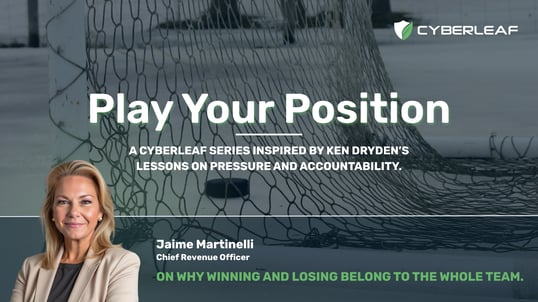 We Win as a Team and We Lose as a Team, with Jaime Martinelli →
I played hockey throughout my youth, and into college, forward, and I was captain of my team for a lot of those years. I never played goalie. After a tight one-nothing game where the puck got past our goalie, I'd usually end up talking to her, and what it always came down to was that she was the last line of defense. It had to go through five people to get to her, which means five of us didn't do our job; the miss wasn’t hers alone to carry.
This month our team at Cyberleaf is working through the lessons in Ken Dryden's book The Game. Our CEO, Jeff Buss, wrote a piece about playing your position and what Dryden taught him about defending the net. My marketing team asked me what "failure can't be outsourced" means to me, and here's my take on it.
During my hockey days I could have a bad shift as a forward and skate off, and it didn't follow me anywhere. Now that I'm running a sales team, salespeople live next to their name. The deal you lost is a fact about you, and it stays a fact about you until somebody tells you otherwise.
I worked one deal for a year early in my career, flying out to California almost every week. By the end, I'd built the relationships and run the process the way I was supposed to, and we lost it anyway. It was a multimillion-dollar deal at a growth-stage company that needed the revenue, and I was the only salesperson heading up the opportunity, so there was nobody else it could belong to. I was the goalie, and I was fairly sure I was going to lose my job over it.
The CEO at the time told me I'd run the process perfectly, that they loved me, and that the other vendor had something we could not deliver. He said getting that far without it was the proof of how good I was at the job… And then, he said the part I have never forgotten:
"We win as a team and we lose as a team."
That's the most powerful thing any sales leader has ever said to me, and I can tell you exactly where I was standing when he said it.
As a sales leader myself now, what happens after you lose a deal is the part I care about most. For the ones you don't win, go back to the client and ask their reasoning for choosing another vendor. It might not be a call everyone enjoys making, but it brings something useful to light for the next opportunity. I've always pushed my team to make it and then bring back what they heard, because there's a good chance whatever happened to them has happened to someone else in the room. We learn as much about our own strengths and weaknesses in a loss as we do in a win. A loss shouldn't be a source of shame but a source of truth and learning.
That’s the whole point of a loss debrief: sales is about helping your customers solve their business problems, and at Cyberleaf, our clients have high-stakes problems to solve. Helping them do that means every "no” must equip us to help the next client solve their problems better.
I didn't get good at hockey just because I liked the sport; you get good when you show up, and for me that meant the rink at four in the morning, Monday through Friday, from twelve years old until I graduated college – games every weekend while my friends were at homecoming, or the party du jour. The discipline came from showing up that way, and sales works the same. You get better with reps and you get better with a coach, because it's hard to teach yourself a trade or a sport without people around you to keep learning from.
My team has heard me say this more times than they'd like, “You don't get every deal you deserve, and you don't deserve every deal you get.” Some close overnight because somebody made a phone call for you, and the ones that break your soul are the ones you spent a year on, on site, grinding, doing everything right.
So if you're sitting on a hard no this week, make the call and bring back what you heard. We win as a team and we lose as a team, and you're one deal closer to a win.
I first read it while I was teaching at the Naval Academy, coaching my son's team on the side, watching one kind of transformation happen in the classroom and another on the ice. Midshipmen were turning into officers in real time, heading off to defend our Nation, while my son was learning to play one of the hardest positions in sports. Dryden gave me language for both, and I still go back to it. Here's what stuck, from the book and from the life Dryden built after it.
– Jaime
Originally published on LinkedIn by Jaime Martinelli, Chief Revenue Officer at Cyberleaf.


.png?width=95&height=125&name=Threat%20Report%20(1).png)